
What’s Really Driving LTL Costs in 2026 — And What SMB Shippers Can Control
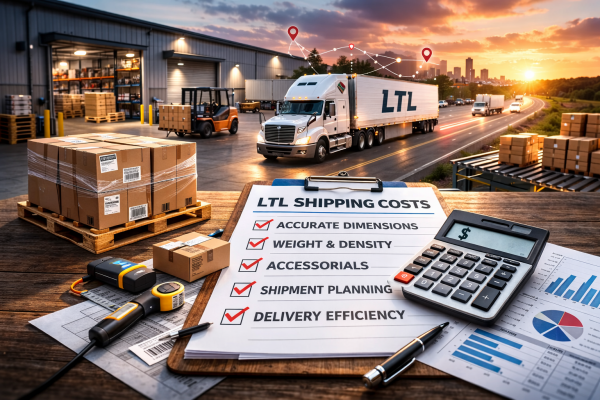
LTL pricing in 2026 isn’t defined by dramatic market swings. Capacity has largely stabilized. Seasonal volatility has been moderate. Rate environments are more predictable than in recent years.
And yet many small and mid-sized business shippers are still asking the same question:
Why do our LTL invoices look different than we expected?
The answer isn’t a market shock. It’s execution.
In today’s environment, LTL cost variability is less about broad rate increases and more about how shipments are prepared, classified, and routed. The difference between an accurate shipment and a reactive one can significantly impact total cost.
Understanding the true drivers behind LTL pricing in 2026 is the first step toward controlling it.
1. Shipment Accuracy Is Now a Primary Cost Lever
Accurate weight and dimensional data have become critical. Carriers are increasingly using scanning and dimensioning technology within terminals. When shipment details don’t match what was declared, reweighs and billing adjustments follow.
Even small discrepancies can trigger:
- Reclassification fees
- Reweigh charges
- Administrative adjustments
- Delays in invoicing
In a balanced capacity environment, carriers are focusing on yield optimization. That means shipment precision matters more than ever.
For SMB shippers, this creates an opportunity. Improving measurement processes, pallet configuration, and documentation accuracy can reduce unnecessary cost exposure without renegotiating rates.
2. Accessorial Charges Are Quietly Increasing Total Spend
Base rates often receive the most attention, but accessorial charges frequently account for a growing portion of total LTL spend.
Common examples include:
- Liftgate service
- Residential delivery
- Limited access locations
- Appointment scheduling
- Detention
These aren’t new fees, but they’re more consistently enforced and more visible in carrier billing systems.
For many SMBs, reviewing accessorial frequency is one of the fastest ways to uncover avoidable costs. In some cases, minor operational adjustments — such as consolidating delivery points or improving dock communication — can reduce these recurring charges.
3. Density and Dimensional Factors Still Matter — But They’re Not the Whole Story
The industry shift toward density-based pricing models hasn’t disappeared. Dimensional weight and freight density remain important elements in cost calculation.
However, density is now one part of a broader pricing equation.
Rather than focusing exclusively on freight class debates, successful shippers are evaluating:
- Packaging efficiency
- Pallet stack height
- Load configuration
- Shipment consolidation opportunities
These adjustments improve cost outcomes without requiring constant rate renegotiation.
4. Shipment Timing and Volume Consistency Influence Cost Stability
LTL networks operate most efficiently with predictable volume patterns. Irregular shipment flows — sudden spikes followed by gaps — can affect routing efficiency and pricing consistency.
SMBs that align shipping cadence with demand forecasts often see more stable invoice outcomes. This doesn’t require massive volume — it requires planning discipline.
Even modest improvements in shipment scheduling and order batching can influence overall cost structure.
5. Inventory Placement Impacts LTL Spend More Than Many Realize
Transportation and warehousing decisions are increasingly interconnected. Inventory positioned closer to customers reduces mileage and transit complexity, which can lower LTL costs and reduce accessorial exposure.
Conversely, centralized inventory without strategic outbound planning can increase freight costs even if storage rates appear competitive.
Integrated logistics strategy — where warehousing and LTL planning are aligned — often yields better results than treating them separately.
What SMB Shippers Can Control in 2026
The current freight market rewards preparedness rather than reaction.
SMBs that succeed in this environment typically focus on:
- Measurement and documentation accuracy
- Packaging optimization
- Accessorial review and reduction
- Shipment planning discipline
- Integrated transportation and warehousing alignment
These areas are operationally manageable and often produce measurable savings without relying on broader market shifts.
At Amware, we work with SMB shippers who want more than a competitive base rate. Our approach combines:
- LTL expertise grounded in real-world execution
- Integrated distribution and warehousing strategy
- Real-time rate visibility through Amrate
- Practical shipment planning support
Rather than chasing every market fluctuation, we help clients build cost control into their daily operations.
Because in 2026, LTL success isn’t defined by avoiding volatility — it’s defined by managing the details.
If you’d like to evaluate what’s truly driving your LTL costs and where improvement opportunities exist, our team is ready to help.